
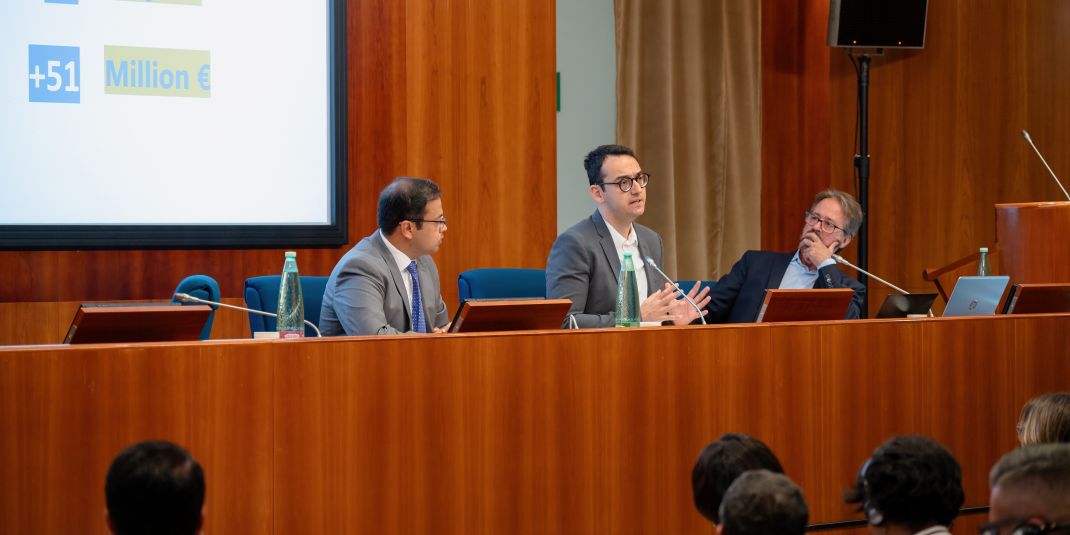
The closing event for the SkillNet project brought a range of Italian and Pakistani actors together to celebrate the project’s successes in Rome on 25 September 2025.
Over the previous year and a half, the project engaged partners and conducted research at national and regional level on current labour market demand and skill profiling. The research findings aim to inform potential mobility and integration of Pakistani foreign workers to fulfil the demands within the Northern Italian region of Piedmont and in Italy at large.
A regional focus with an international outlook
As Maruan Oussaifi, Vice President – ANOLF, National Association Beyond Borders, described, “The challenge is perfectly clear: our companies are searching for skilled workers. We can be the bridge for that.”
Taking this regional approach as a basis, SkillNet sought to validate a methodology for creating regular labour mobility pathways between Italy and Pakistan, whilst also promoting concrete opportunities for cooperation between the two countries, and potentially other EU Member States.
The Government of the Piedmont Region formally endorsed the initiative, providing a letter of institutional support and expressing interest in future collaboration. This endorsement reinforced the political legitimacy of the project and laid the groundwork for long-term cooperation at the regional level.
The closing event was part of the official agenda of an institutional visit to Italy by a delegation of Pakistani stakeholders, including representatives from academic and TVET institutions and government ministries, demonstrating the ambition to serve as a case study for future labour mobility pathways and overall stronger cooperation between Italy and Pakistan.
As Claudio Cappellini, Head of EU Policies – CNA, National Confederation of Crafts and Small and Medium Enterprises, stated, “Thanks to the SkillNet project, we now know we can build a much bigger labour migration scheme together.”
Building the foundations for further cooperation
Whilst research activities were taking place, others focused on capacity development with national authorities with the goal of aligning Pakistani training curricula with skills needed in Italy. Through bilateral meetings, institutional exchanges, and participatory focus groups, SkillNet built trust and enabled cooperation among a diverse set of actors, including public institutions, private sector companies, vocational training providers from both Italy and Pakistan.
The 2024 EU Talent Partnership with Pakistan marked a significant milestone in developing a strategic framework for the EU, EU Member States, and Pakistan to develop a coherent set of actions on labour mobility and skills development. On a national level, SKillNet’s approach is in line with the most recent migration policy developments in Italy, including the Flow Decree (Decreto Flussi) on October 3, 2023, which emphasises the reduction of the gap between the scale of incoming migration flows and labour market demand, the enhancement of economic sectors, and the strengthening of vocational training tools in countries of origin.
A strategic opportunity arose when a new dedicated working group on labour mobility initiatives was created by the EU Delegation to Pakistan. SkillNet’s integration into this platform enabled synergies with ongoing complementary projects, opening new avenues for knowledge sharing, impact and collaboration.
Research as foundations to support legal labour pathways
SkillNet developed two research studies (available in English and Italian) at national and regional level.
The first, at national level, initially identified four priority sectors of Care and Assistance, Tourism and Hospitality, Construction, and Agriculture in Italy. These sectors were not only characterised by strong recruitment needs but also by a high incidence of regular immigrant employment, making them highly relevant to the project's objectives.
The second, ‘Professional Needs, Training and Skill Classification Systems: An Analysis of Piedmont and Pakistan’ is structured around three main areas of research: first, an analysis of the labour market in Piedmont, second, an overview of the Pakistani education and training system and third, an in-depth analysis of the regional training system in Piedmont.
These findings informed the identification of four priority sectors for labour mobility: Mechanics, Tourism, Construction, and Textile, areas that reflect regional labour shortages and Pakistani training strengths. The research further identified 16 strategic professional qualifications for the labour market in Piedmont and assess their comparability and transferability with the Pakistani education and training system, with a view to improve pre-departure training.
Next steps beyond the MPF Grant
SkillNet is investing in the sustainability of its results. It produced high-quality, actionable outputs, including the ‘Migrant Talent Pipeline’ methodology, targeted research publications, and policy briefs. Its stakeholder network was nurtured to grow as a long-term asset, capable of supporting ongoing dialogue, institutional alignment, and future implementation of mobility channels between the two countries.
Project background
The 19.5-month ‘Strengthening Legal and Skilled Circular Migration through Cooperation between Italy and Pakistan’ SkillNet project was funded by the European Union through the Migration Partnership Facility and implemented by National Association Beyond the Borders, Piemonte – ANOLF Piemonte (Italy), in collaboration with Trade Union Institute for Development Cooperation - ISCOS (Italy) and Confederation of Italian Trade Unions - USR CISL Piemonte (Italy).