
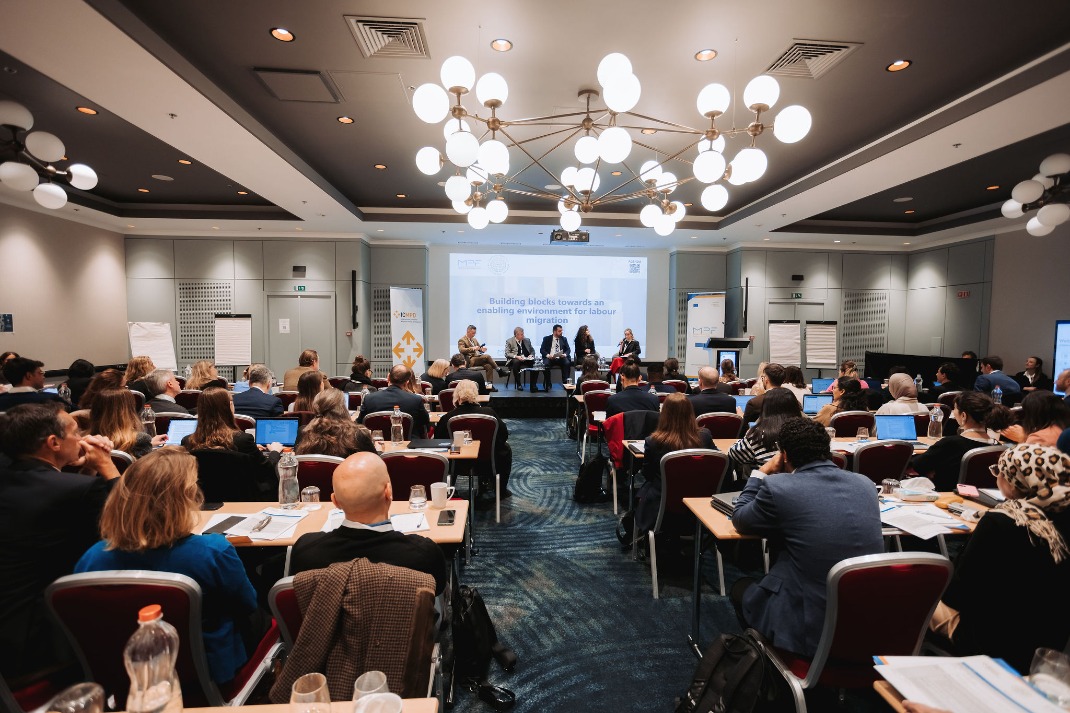
The fourth EU Labour Mobility Practitioners’ Network (LMPN) Conference, held in Brussels on 18–19 November, brought together policymakers, practitioners and international partners to explore how labour migration can be made smoother, more effective and sustainable. Under the theme “From Lessons to Levers: Driving the next phase of labour migration”, discussions focused on mechanisms that influence outcomes—whether through innovation, operational improvements or strategic partnerships.
Innovation as a Lever for Change
Digitalisation emerged as a recurring theme, with several speakers emphasising its potential to streamline processes and protect migrant workers’ rights. Such is the case of Estonia when it introduced a Single Window Access for employers and employees, enabling data sharing between authorities and ability to monitor over migrants’ labour rights.
Technology-driven solutions were also highlighted in the workshops, where participants discussed AI-supported matching and language learning tools, databases of recognised diplomas and one-stop-shop websites. These innovations aim to reduce administrative bottlenecks and improve transparency in recruitment processes.
Skills and Talent Pathways: Building Blocks for Competitiveness
A suite of policy tools focuses on enabling regular migration, including the Communication of Union of Skills, the EU Startup and Scaleup Strategy, the Pact for Mediterranean and in the near future, the EU Talent Pool. However, speakers at the conference underscored the importance of skills recognition and mobility within and beyond the EU for which persistent barriers remain. The European Labour Authority (ELA) mapped the obstacles and barriers to labour market participation for migrant workers in Europe. These include language proficiency gaps—one in four migrants is not fluent in the host country’s language—and low recognition of foreign qualifications, which is often costly and cumbersome.
To address some of the current shortcomings, the comprehensive Union of Skills strategy will act upon four strands: leveraging the skills of the EU workforce, reskilling, facilitating circulation of skills within the EU, and attracting talent from beyond its borders.
Global Perspectives: Lessons Beyond Europe
Insights from Canada, Pakistan and the Philippines enriched the debate, offering transferable lessons for European practitioners who are the core audience of this conference and network. Canada highlighted its shift to a whole-of-government approach, introducing the Chief International Talent Officer and multi-year planning to align migration with economic priorities, while tackling credential recognition for better integration. Pakistan emphasised safe and orderly migration through the recent signing of the EU Talent Partnership Agreement, alongside efforts to improve language training and skill certification. The Philippines presented its Department of Migrant Workers, consolidating services across the migration cycle and advancing labour diplomacy through 70 agreements, including 14 with the EU. Speakers stressed solutions like lifelong learning frameworks, cybersecurity partnerships, and co-management of migration to address challenges such as skills mismatch, visa delays, and worker protection. Collaboration among governments, private sector, and unions emerged as a key driver for sustainable, rights-based labour mobility.
Persistent Challenges and Practical Solutions
Despite progress, visa processing times and language barriers continue to hinder mobility, as a few MPF projects have experienced. Meanwhile, workshop discussions explored pre-departure language training and AI tools to reduce linguistic hurdles, particularly for SMEs. Through the European Investment Bank, EU Member States are accessing loans and other financing instruments to develop practical projects; for example, in Finland the new Helsinki Vocational Education Campuses will play a pivotal role in the integration of recently arrived migrants into the Finnish labour market.
Looking beyond the usual players
Diaspora groups, as highlighted by a joint MPF- EU Global Diaspora Facility study from 2021, can contribute to achieving the objectives of the EU’s Talent Partnerships in areas such as facilitating skills mobility, circular migration partnerships, and entrepreneurship. Good practices were shared from on innovation Morocco and Ghana, bridge building, knowledge transfer, and short-term return schemes in the Philippines and Armenia, and mentorship, pre-departure training, and advocating for fair labour migration frameworks Morocco, Egypt and Tunisia.
Barriers to engaging diaspora in labour mobility remain, including diasporas’ fragmentation and limited coordination, the sustainability of schemes, integration barriers, the lack of systemic mapping of skills, gaps in monitoring and evaluating diaspora contributions to labour mobility schemes, and over-reliance on diaspora networks/actors.
Sustainability and Financing
Financial factors significantly shape the design and impact of labour mobility schemes. Past experiences show that many programmes remain small and costly to operate, and public funding cannot be assumed. In addition, private-sector actors remain hesitant due to concerns about return on investment versus commitments.
Speakers called for new models such as employer-funded recruitment, public-private cost-sharing, and outcome-based financing.
As the Centre for Global Development’s 2022 research pointed to, out of 57 pathways analysed, most projects are small or pilots, lacking sustainable financial structures with the vast majority funded by government contribution and heavily dependent on which way the wind turns in terms of political priorities. Investing in quality training by destination countries as a steppingstone to building tailored projects would be one way out of the current impasse.
The World Employment Confederation’s temporary agency model provides services, including training and reskilling initiatives, transport costs, fair housing projects for migrant workers, and health and safety campaigns as a necessary investment given Europe's labour market needs. Putting the SUSTAIN project as a example, Seefar Foundation called for simplifying processes, understanding the motivation of actors and ensuring that financial incentives are included as part of the overall framework.
Looking Ahead: Priorities for 2026
As the conference drew to a close, attention turned to the future. Many speakers and participants alluded to the need to move beyond a pilot project approach to a more embedded system. MPF’s answer to this question is rooted in the concept of “blueprint”, a series of essential features that can inform and guide the iteration and scalability of pilot projects into permanent programmes.
Through the MPF, the LMPN will present several initiatives in 2026, including a research piece on the portability of pension rights for non-EU nationals returning to their countries of origin, a modular blueprint for seasonal worker schemes to strengthen ethical recruitment practices and a study on how SMEs can attract and retain talent through bridging actors such as professional associations and municipalities. In collaboration with Labour Mobility Partnerships (LaMP), members can expect to see a proposal for a competency framework for healthcare assistants. These outputs will be published as policy briefs—the preferred format among network members—and complemented by online focus sessions and sector-specific workshops throughout the year.
An Ecosystem Approach
The conference reaffirmed that labour mobility is not an isolated endeavour but part of a broader ecosystem involving governments, private sector actors and international partners. Participants highlighted a growing shift toward co-managed migration systems and long-term partnerships designed to align skills with labour-market needs, safeguard workers, and anchor mobility within broader development strategies. With the fifth edition of the Annual Conference and the tenth anniversary of the Migration Partnership Facility on the map for 2026, the LMPN is poised to continue shaping policies and practices that make labour migration fair, efficient and future-ready.
The report of proceedings is forthcoming and will be accessible to LMPN members in the registered area of the website. For more information on membership and eligibility, please visit the LMPN webpage.
Related Articles
Six key take-aways from the Labour Migration Practitioners' Network 2024 In-Person Conference