
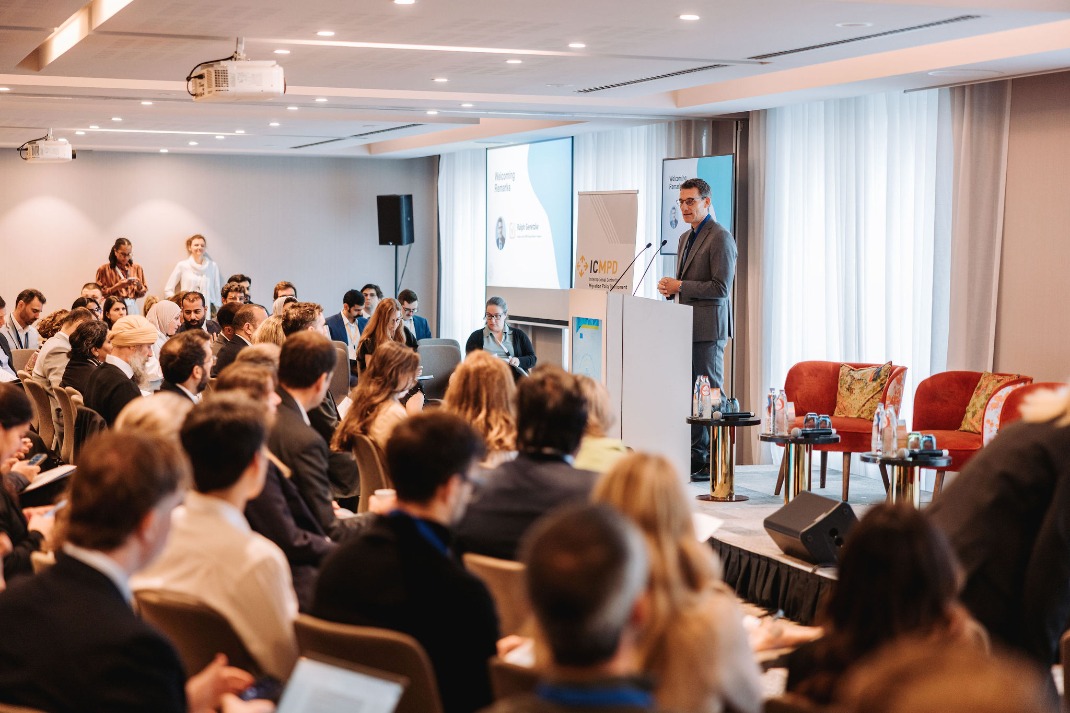
On 13 and 14 October 2026, over 150 participants gathered in Brussels for the EU Labour Mobility Practitioners’ Network fifth in-person conference, “Beyond policy: Making EU labour mobility work in practice” to discuss practical conditions required to design labour mobility pathways that are effective, fair and sustainable.
The two-day conference brought together representatives of EU institutions, national authorities, employers, international organisations, social partners, researchers and practitioners. Discussions examined current labour-market needs, employers’ recruitment realities, candidate preparation, matching and selection, onboarding and retention, the recognition of skills and qualifications, recruitment in health and long-term care, and temporary and seasonal mobility.
From labour demand to sustainable delivery
Conference discussions confirmed that migration can help mitigate workforce decline and labour shortages but also highlighted that effective pathways require credible information on occupational needs, investment in education and skills, predictable administrative processes, and coordination among employers, public authorities, training providers and partner-country institutions.
The employer perspective exposed several unresolved questions. Participants discussed the limited uptake of international recruitment among small and medium-sized enterprises and the difficulty of translating identified labour demand into mobility at scale. They also agreed that greater involvement from financial actors would be an important follow-up point if labour mobility initiatives were to become commercially sustainable. There is a need to explore models to de-risk investment by the private sector and international workers.
Expectations surrounding the forthcoming EU Talent Pool were high. The contribution of this new platform will ultimately depend on how effectively it connects employers, skills systems and existing recruitment and integration structures.
Practitioners shared tried-and-tested formulas for success
Participants agreed that feasibility must be tested from the outset against immigration and visa rules, qualification requirements, sectoral regulations, diplomatic priorities and partner-country interests. Employers should be involved early so that pathways reflect genuine vacancies, skills needs, language requirements and realistic recruitment timelines. They also cautioned that employer commitment must be concrete: projects require real vacancies and businesses able to plan ahead and absorb candidates.
Further practical recommendations across the mobility cycle
Three Practice Labs examined three crucial stages of the mobility cycle, namely 1) candidate preparation, 2) matching and selection, and 3) onboarding and retention. Recommendations included support for family members that accompany the worker, workplace mentoring and buddy schemes, one-stop shops bringing services together, and employer networks through which organisations can exchange experience.
Skills recognition remains a central point of discussion
The second day started by underscoring a persistent challenge: skills can only travel when they can be reliably recognised, validated and communicated. Formal qualifications do not always convey the full range of a candidate’s competences, while professionally valuable experience can be difficult to translate and recognise across national education and labour-market systems.
There was broad agreement on the need for closer alignment among qualifications frameworks, industry standards, employer requirements and skills assessment. Participants looked ahead to further policy developments on skills recognition through the Skills Portability Initiative, while examples such as an Egypt-Germany certification pilot illustrated how trust and verification can also be strengthened through bilateral and sector-specific solutions.
Sessions on long-term care, temporary pathways and seasonal work reinforced another area where no single solution exists: how to reconcile urgent European labour demand and commercial viability with fair recruitment, worker protection, partner-country interests and sustainable outcomes. These dimensions require continued discussion, evidence and testing rather than a one-size-fits-all model applied across sectors and countries.
A forthcoming ICMPD publication supported through MPF will inform these discussions by establishing a series of blueprints to develop fair and sustainable seasonal mobility in the agriculture and tourism sectors.
From conference exchange to collective follow-up
The conference demonstrated the value of the EU LMPN as a year-round Community of Practice, with active participation continuing through online meetings, webinars and focus sessions. Trust amongst community members was evident in the openness of the discussions and the exchange on challenges and solutions.
Related articles
Fourth EU LMPN Conference gathers practitioners in Brussels - Migration Partnership Facility
Six key take-aways from the Labour Migration Practitioners' Network 2024 In-Person Conference