
This article provides a high-level overview of the achievements from MPF III as the phase closes on 30 June 2026.
MPF III achievements
On 30 June 2026, the third phase of the Migration Partnership Facility — MPF III — closes, but the story does not end and the programme is set to continue until at least the end of 2031 with MPF IV ongoing already and MPF V in planning. Launched on 01 January 2020, 36 projects launched activities under MPF III, working on thematic areas such as regular migration and mobility, intelligence-gathering to prevent irregular migration, and safeguarding vulnerable groups, including children, displaced populations and victims of trafficking. After six and a half years of implementation, it is possible to analyse how much has been achieved, how much has been learned, and how far the Facility has evolved in supporting the external dimension of EU migration and asylum policy.

“MPF III’s external evaluation shows that this phase saw a step change. Whilst earlier phases focused primarily on establishing the grant mechanism and its procedures, MPF III moved towards improving the strategic relevance, design quality, implementation support and applying learning from projects. The Facility became more than a channel for EU funding: it developed into a flexible migration policy instrument — a “Swiss army knife” of migration policy tools — able to respond to diverse policy needs and operational contexts while maintaining a coherent contribution to EU priorities”, said Jennifer Tangney, Senior Programme Coordinator, MPF.
Delivering results in a difficult operating environment
MPF III was implemented during a period marked by major disruption. Projects had to navigate the COVID-19 pandemic, Russia’s war of aggression against Ukraine, political instability, government reshuffles, inflation, energy crises, procurement delays, visa bottlenecks, shifting labour-market demand and changing regulatory environments.
These external factors affected mobility schemes, in-person training, procurement, travel, stakeholder engagement and project timelines across the portfolio and the Facility was able to adjust to changing circumstances to enable grantee success. Projects reacted by going online when travel became impossible, adjusted procurement when markets changed, recalibrated timelines when political or administrative processes slowed, and used ICMPD’s support to maintain momentum through uncertainty.
Learning through challenges: MPF’s distinctive added value

One of the strongest findings of the external evaluation is that MPF III’s added value lies in its way of working. The Facility provided intensive incubation and accompaniment from concept development through implementation, helping grantees strengthen project design, apply recommendations, address procurement and monitoring issues, and adapt to changing circumstances. The evaluation identified strong stakeholder ownership, conscious project design, robust monitoring and evaluation systems, adaptive management, political commitment and stable institutional conditions as key success factors.
Beyond projects: generating knowledge for practitioners
Knowledge production also expanded with 89 research reports, both from the side of grantees, who began publishing an array of practitioner-oriented research and assessment papers, and from MPF side, especially on topics around Regular Migration and Mobility. Through its expanded Knowledge Management and Communications component, MPF III was able to support the landmark publication of EU-27 wide Legal Pathways Mapping in 2023-2024, offering a bird's eye view of the legal channels and requirements that each EU Member States capitalises on to promote regular migration. An updated version is in the works and should be published next year in 2027.
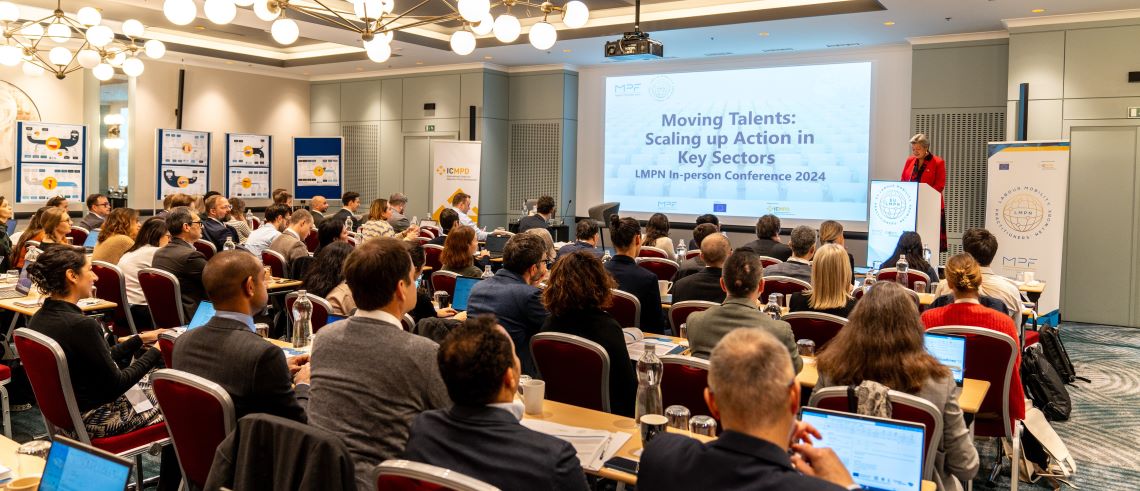
The EU Labour Mobility Practitioners' Network launched in early 2022 and since then has offered a space for 300+ members to convene and discuss policy updates, lessons learned derived from projects, and other points of interest. The Annual Conference draws in a loyal crowd of attendees once a year in Brussels.
A stronger foundation for what comes next
As MPF III closes, its legacy is not only a list of completed projects. It is a stronger, more mature approach to EU migration cooperation: one that is more evidence-based, more adaptive, more attentive to quality, and more capable of learning from both success and difficulty. With a new Call for Proposals in the pipeline and the continuation of MPF until 2031, the migration partnerships established through the Facility are set to consolidate even further.

As Oleg Chirita, Deputy Head of ICMPD Brussels Mission and Head of Unit, Global Initiatives noted, "MPF III shows that migration partnerships are built under complex conditions. Its achievement lies in having delivered results while adapting to disruption — and in having turned those challenges into learning for future cooperation. On 30 June 2026, MPF III closes with a substantial record of projects, partnerships, tools and knowledge. More importantly, it leaves behind a stronger foundation for the continued development of flexible, practical and partnership-driven approaches to the external dimension of EU migration and asylum policy."